


Select Country

Don’t have your Nedbank ID yet?
Nedbank ID single sign-on gives you full digital access to Nedbank’s banking and lifestyle products and services on the Money app or Online Banking.
Log in
Log in to Online Banking or another one of our secured services.
 Find us


- Login & Register
- Online Banking
- Online Share Trading
- NedFleet
- Register for Nedbank ID
- About us
- Deals
- Explore About us
- Deals
- Culture
- Explore Culture
- Sustainability
- Explore Sustainability
- Financing
- Trading
- Transacting
- Investing
- Advisory
- London
- Insights
- Articles
- Research
- Explore Insights
- Articles
- Investor research
- Investor-research
- How loadshedding impacts inflation | Nedbank CIB
- Contact us
- Explore Contact us
Embedded generation: The next vital developments to an energy-secure South Africa

Improved legislation, aggressive financing terms from funders and assistance from developed countries to aid South Africa in alleviating energy crisis.
There is a significant interest from energy consumers looking to access electricity through embedded generation from predominantly renewable energy projects. The interest has ranged from smaller onsite projects to large offsite projects where the electricity will be wheeled across the national electricity grid, from the generating project to wherever the consumer is located in South Africa.
The energy sector welcomed President Ramaphosa's announcement (and the subsequent amendment of the Electricity Regulation Act) to exempt small-scale embedded energy-generation projects of up to 100 MW from having to apply for generation licences from the National Energy Regulator of South Africa (Nersa).
The amendment to regulatory framework has catalysed a response from many major corporates led, unsurprisingly, by the country’s mining sector and other large energy consumers. Many of these large corporates have unveiled plans for massive energy-generation programmes, with some entities aiming to procure between 3 to 5 GW within the next five to 10 years. Given the renewed focus on climate-related issues for a number of corporates, it is also expected that more and more corporates would look to either develop embedded onsite clean energy sources (behind the meter) where possible, or use wheeling as a source of procuring clean energy.
Nersa's quick response to registering projects that qualify for the licencing exemption is encouraging. Some of the projects received Nersa registration in a record time of 19 days. From 7 June 2022, Nersa had approved 217 applications so far since the legislative change in October 2021.
Financial institutions, on the other hand, have also responded positively to these developments, and we are already seeing aggressive financing terms from the funders, with some closely aligned to REIPPPP style terms. In the Corporate and Industrial (C&I) energy space, we are also starting to see projects proposing to have multiple power-purchase agreements (PPAs) with an aggregate model being established.
Some developed countries also offered their support to South Africa to help the country’s transition to clean energy. The aim now remains to get the first of these projects completed and to successfully generate much needed energy that will assist Eskom with the increasing demand and economic recovery, following the Covid-19 pandemic.
Generating electricity is only one part of a sustainable energy equation. South Africa has one of the most complex distribution grids on the continent, and the limitations of that grid are already being revealed through constraints on its ability to carry all the energy now being produced, including the power flowing from the various REIPPP projects. Although the Northern Cape has depleted their grid capacity*, we are now seeing developers exploring other provinces such as North West, Free State and Limpopo, which demonstrates that developers still consider South Africa to be a key destination for energy investments.
It is evident that grid access is a critical component of rolling out new generation of capacity, and is desperately needed to end the continuous load shedding in the country. Both private and public sectors are engaging to find a way forward to expand the power grid and accommodate the capacity of new projects, considering also the capacity required to connect REIPPPP bid window 5 and 6 projects, the Risk Mitigation Independent Power Producer Programme (RMIPPPP) projects, as well as other future programmes and C&I wheeling projects.
However, to achieve this, many of our energy stakeholders must broaden their focus. Targeted private-sector investment into grid infrastructure will be key, as will support to municipal generation programmes and organisations with plans to meet the majority of their energy needs themselves. Eskom alone cannot manage the demand. Everyone has a part to play to resolve our ongoing energy crisis. During SONA, the President also highlighted the government's need to consider embedded energy generation through net metering and the use of rooftop PVs to ease the pressure on Eskom.
At Nedbank, we continue to closely follow the work underway by Eskom and the government to unbundle Eskom into three separate entities focusing on generation, transmission and distribution. This unbundling will result in an independent grid operator that will further enhance the private sector's investments in the energy sector.
Loadshedding remains a constant concern and the industry estimates that it will continue to be a challenge in South Africa for the next 10 – 15 years. Renewable energy will be a critical component to help end this crisis, especially when we consider decommissioning of the ageing coal-fired power stations over the next three decades. We also understand that the government is actively working to revise the 2019 Integrated Resource Plan (IRP2019) to consider the country's energy requirements, and in future, we may see that the bulk of the energy mix will come from renewable-energy sources.
As a well-established leader in renewable-energy funding and advisory services, Nedbank is committed to supporting and working with all energy stakeholders to achieve projects that have the capacity to help solve our country’s electricity challenges, and to do so in a way that helps realise South Arica’s economic growth aspirations and social development priorities. In the embedded energy-generation space, Nedbank proactively established the Embedded Generation business sub-unit in 2015 to support clients who are working towards generating their own secure, reliable and affordable renewable-energy supplies.
Nedbank will continue to scale up its commitment towards the fast-growing renewable-energy sector, in line with the need to support socioeconomic development objectives while driving the transition to a zero-carbon energy system. Our mandate at Nedbank CIB is to retain our market-leading position, continue to actively participate in all renewable-energy programmes, and extend our lead in the C&I energy space.
* According to the Generation Connection Capacity Assessment (GCCA) for 2023, published by Eskom and reaffirmed by the
GCCA-2024.
Related posts
See all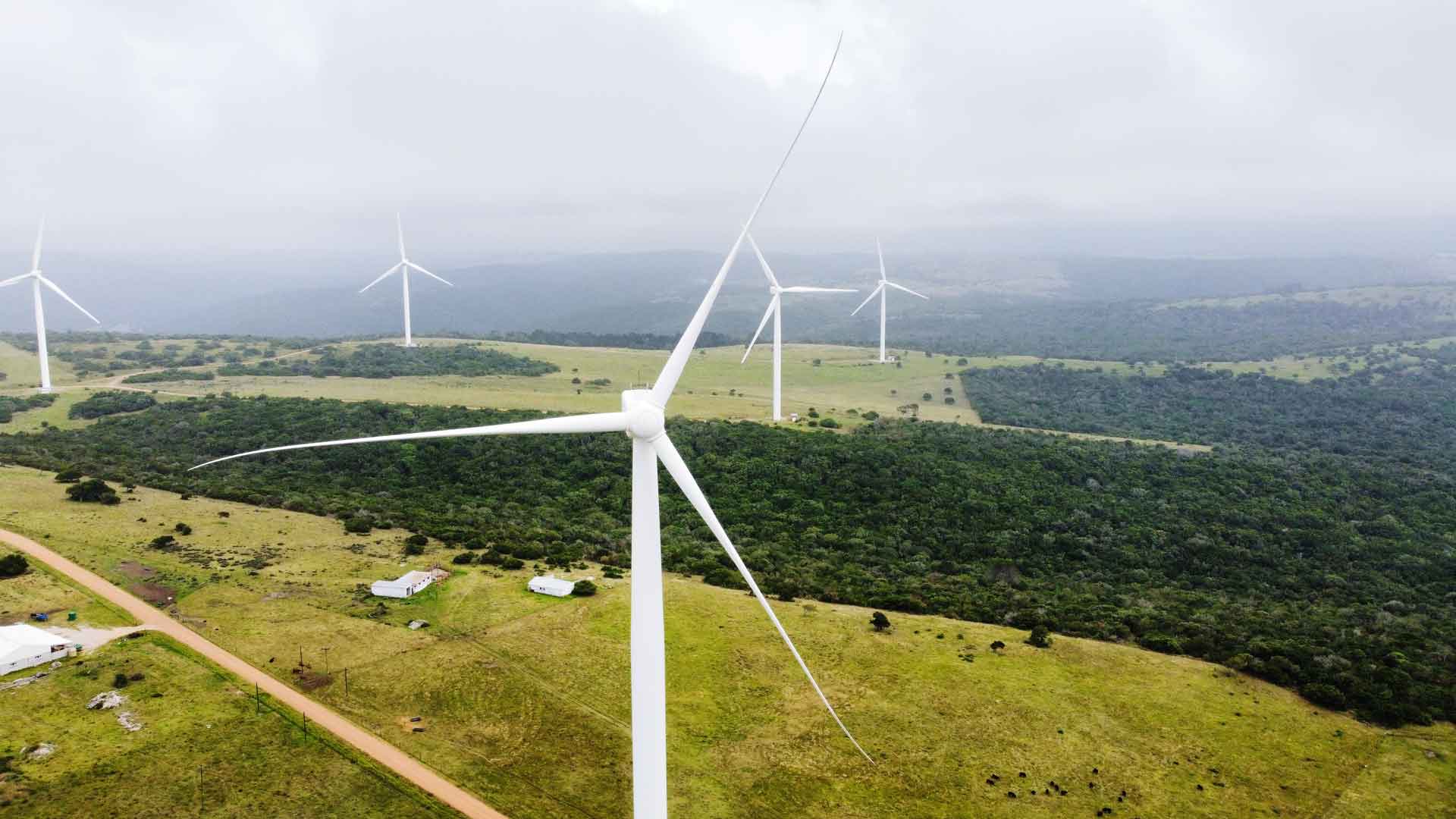

The growth of sustainable finance in South Africa
As part of an expert panel at the 2022 South African Real Estate Investment Trust Conference, Arvana Singh, Nedbank Head of Sustainable Finance Solutions, shared some thoughts on how sustainable finance in South Africa can help mitigate ESG-related risks.
Published 09 May 2023 in nedbank:cib/articles/property

The growth of sustainable finance in South Africa
As part of an expert panel at the 2022 South African Real Estate Investment Trust Conference, Arvana Singh, Nedbank Head of Sustainable Finance Solutions, shared some thoughts on how sustainable finance in South Africa can help mitigate ESG-related risks.
Published 09 May 2023
Nedbank Corporate and Investment Banking honoured for leadership in sustainable finance
Our ESG-backed approach to lending and financing was recognised at the 2022 Global Finance Sustainable Finance Awards, where we ranked in the top 6% of banks globally and received awards for Outstanding Leadership in Green Bonds and Outstanding Leadership in Transition/Sustainability-linked Bonds.
Published 09 May 2023 in nedbank:cib/deals/esg
Nedbank Corporate and Investment Banking honoured for leadership in sustainable finance
Our ESG-backed approach to lending and financing was recognised at the 2022 Global Finance Sustainable Finance Awards, where we ranked in the top 6% of banks globally and received awards for Outstanding Leadership in Green Bonds and Outstanding Leadership in Transition/Sustainability-linked Bonds.
Published 09 May 2023
